NEWSLETTER - 3rd Edition
We’re pleased to share the third and latest newsletter from the Magaliesberg Biosphere—a platform for sharing stories, activities, research, and matters of interest from across the biosphere. This space is shaped by its stakeholders, and we invite you to contribute. If there’s a topic you’d like us to cover, or if you have an article or update to share, we’d love to hear from you. Please send your ideas, requests and comments to media@magaliesbergbiosphere.
We sincerely thank Elme and Andre Coetzer for sharing their very special encounters with butterflies of the biosphere that you can read in this edition. Be sure to click on their top ten list of nectaring plants and caterpillar host plants to support butterfly abundance!
Hangzhou, The next 10 years.
New Plan and Strategy for the Man and Biosphere Programme
As readers of the Magaliesberg Biosphere newsletter, we all have some connection to the landscape and its identity as a biosphere reserve - but what is the bigger global landscape that the Magaliesberg Biosphere fits within? In this edition, we explore the new Hangzhou Strategic Action Plan, which sets the tone for the Man and Biosphere (MAB) Programme and biosphere reserves for the next decade.
Since its inception in 1971, the Man and Biosphere (MAB) Programme, practically implemented through biosphere reserves like the Magaliesberg Biosphere, has evolved and grown, drawing on learnings from the World Network of Biosphere Reserves (WNBR) and the latest developments in science and research. Over time, this evolution has included the establishment of baseline criteria, the introduction of several strategies and the development of a youth network.
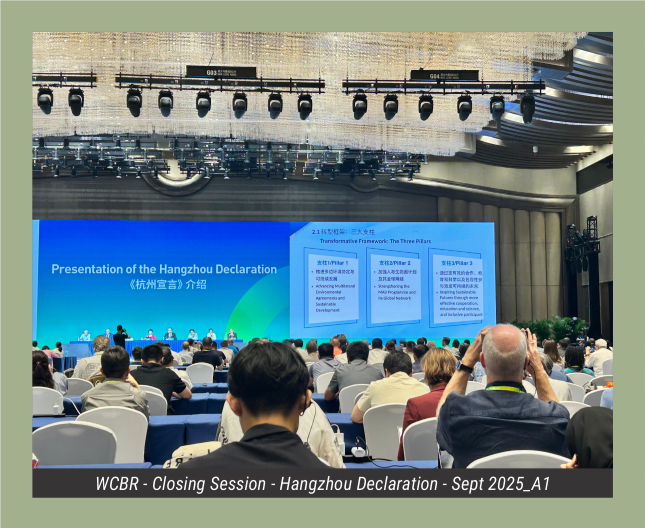
Most recently, at the 5th World Congress of Biosphere Reserves (WCBR) held in Hangzhou, China, from the 22nd to the 25th of September 2025, the next chapter of this evolution was charted out. The final draft of the Hangzhou Declaration and Strategic Action Plan was presented to over 2000 different stakeholders across a number of sectors for endorsement. This follows an extensive drafting process, led by experts from around the world, that occurred over several years and included a public consultation component. In this way, both expert opinion and broad, participatory consultation shaped this next chapter.
The Hangzhou Declaration and Strategic Action Plan is the successor of the Lima Action Plan (2015 – 2025) and builds on some of the previous strategies and goals. It is made up of three overarching objectives with 34 specific action targets falling under these objectives (Table 1). Although focused, the action targets have been structured to avoid being overly quantitative, allowing countries and individual biosphere reserves to set targets that align with their socio-ecological and cultural contexts.
(INFO BOX) - Overarching objectives of the Hangzhou Declaration and Strategic Action Plan
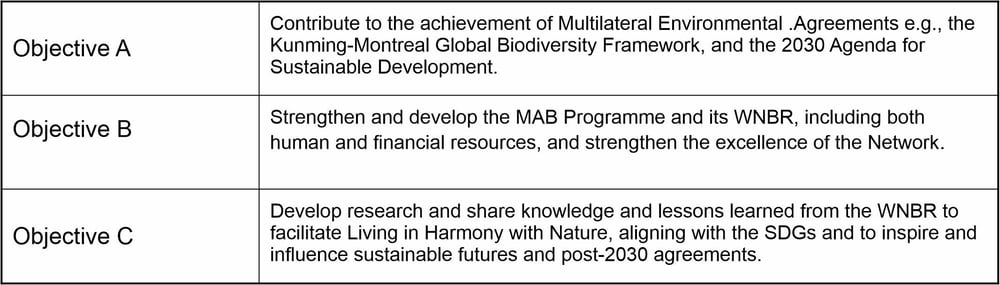
A strong link is established through Objective A of the new Declaration Strategic Action Plan to several other multilateral agreements, with the aim that the MAB Programme and the WNBR should actively contribute to the attainment of the goals within these agreements. This includes the Kumning-Montreal Biodiversity Framework and the 2030 Agenda for Sustainable Development, as well as action targets focused on areas such as addressing invasive alien species, reducing pollution and addressing consumption habits.
Strengthening and promoting excellence in the MAB Programme and the WNBR, including through resource capacitation, is another key objective. The Declaration and Strategic Action Plan has a key focus on equity and justice by setting out action targets that focus on the full inclusion of Indigenous and Local Communities, promoting gender equality and further developing the MAB Youth Network. Further to this, several actions focus on increasing support to biosphere reserves, including promoting more effective National MAB Committees, capacity development through collaboration and enhanced communication, amongst other actions.
Finally, in line with the role of biosphere reserves as sites for logistical support to research, monitoring and training, the final objective focuses on research and knowledge sharing for more sustainable futures. The Declaration and Strategic Action Plan envisions a trajectory that fully leverages the WNBR’s value as sites for research and learning regarding sustainable futures, something that many experts and practitioners around the world note as underleveraged. Action targets include facilitating research partnerships and collaboration, advancing open science and promoting educational initiatives that draw on science and culture.
Dr Kaera Coetzer, a researcher closely aligned with the Magaliesberg Biosphere, was fortunate enough to attend the World Congress, representing the international “BECOME” (Biospheres as Effective Conservation Measures) project that the Magaliesberg Biosphere is also involved in. Of the Hangzhou Declaration, Dr Coetzer notes:
“The Congress provided a key opportunity to review the progress and lessons of the past decade and to shape the new 10-year roadmap for the MAB Programme. We see some of those lessons and imperatives clearly outlined in the Hangzhou Declaration and associated Strategic Action Plan: a focus on collaboration – across BRs, across sectors, across scales; a focus on justice in support of more inclusive and equitable sustainable futures – social justice, epistemological justice and recognition justice; and a focus on leveraging the BR model as a mechanism for advancing key global environmental priorities”
At the core of the Hangzhou Declaration and Strategic Action Plan is a focus on developing biosphere reserves as models of healthy human-nature relations and sites of scientific advancement while ensuring that considerations of justice, equity and solidarity are fundamental to these pursuits. Biosphere reserves and their supporting structures from around the world, including our very own Magaliesberg Biosphere, will strive to achieve these targets over the decade.
Sources:
https://www.unesco.org/en/articles/5th-world-congress-biosphere-reserves
https://unesdoc.unesco.org/ark:/48223/pf0000396262
Magaliesberg Biosphere Periodic Review
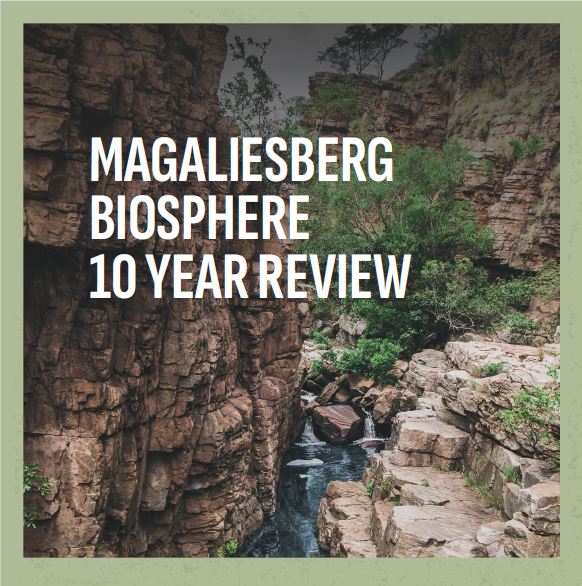
After a decade of the Magaliesberg Biosphere’s formal existence, 2025 was the year the first periodic review was undertaken in the MBR. The 12-month process was led by the Magaliesberg Biosphere NPC and Research consultants Confluence, who brought together the broader community, key actors in the landscape and experts in their fields to put together the research and stakeholder engagement required for the final report. Governance and land-use change aspects drew on recent MSc research at the University of Pretoria. A baseline Ecosystem Services Assessment for the Biosphere, focus group facilitation and stakeholder analysis was completed by specialist consultants.
Overall, the periodic review has been a valuable exercise, providing important insights into where the Magaliesberg Biosphere has been, where it is now and where it must go. A summary of the review and formal submission process will be presented at our AGM in May.
The Butterfly Effect
By Elmé Coetzer and André Coetzer
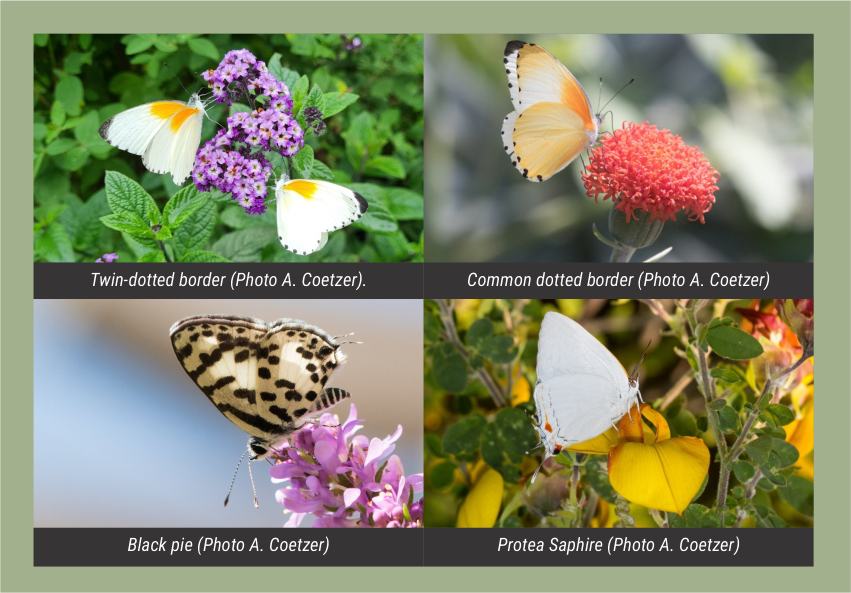
Each small action we took set off a cascading effect across the landscape. Planting nectar-rich flowers didn’t just bring butterflies, it attracted bees, moths, bee flies, wasps, beetles, and countless other pollinators. Clearing invasive species created space for native vegetation to recover, improving soil health and encouraging the return of wildflowers. A water feature with muddy edges became a hotspot for mud-puddling butterflies, dragonflies, and thirsty birds. The surge in insects drew in spiders, robber flies, mantids, dragonflies, lizards, and birds. Allowing wild grasses to grow meant seed for finches and waxbills, cover for ground-nesting birds, and food for small mammals like scrub hares and field mice. As the prey base expanded, so did the list of predators, including raptors, genets, mongooses, monitor lizards, and even the occasional black-backed jackal.
We weren’t just counting butterflies anymore; we were witnessing the revival of a living system. One decision to create a butterfly-friendly garden led to a chain reaction… and that’s the beauty of “the butterfly effect”.
Entropie is not a vast nature reserve or formally protected land. It’s a small space, but far from insignificant. To date, we’ve recorded over 800 different types of organisms through platforms like iNaturalist, Birdlasser, and a custom logging tool. More than 700 of these have been identified to genus or species level, and the list continues to grow. With quiet confidence, we eagerly anticipate reaching the 1000 species milestone in 2026.
When we think about conservation, we often believe it’s limited to large, protected areas and the work of professionals. However, meaningful change can start with anyone, anywhere, and the impact can be just as profound.
If you’re wondering what you can do for biodiversity, take the words of Arthur Ashe to heart: “Start where you are. Use what you have. Do what you can.” Plant an indigenous shrub, let a patch of grass grow wild, add a shallow pool of water, because even the smallest patch of earth has the potential to host a storm of life, and that first flutter of a butterfly’s wing might just be yours...
Acting for the Planet
“Thlago e re Tlhokometse - Nature Takes Care of Us”
The hustle and bustle of drama and the vast and wild natural world may seem like they have very little in common - but they are far more closely connected than you can imagine. If you can’t see the link yet, all you have to do is read more about the Magaliesberg Biosphere’s ‘Thlago e re Tlhokometse - Nature Takes Care of Us’ project in this article!
‘Thlago e re Tlhokometse - Nature Takes Care of Us’ was the first cycle in a 3-year education for sustainability development (ESD) project run by a partnership between the Magaliesberg Biosphere, Drama for Change, and Murray and Dixon Construction. The project aims to raise environmental awareness in exciting, fun ways that encourage creativity, empower the youth and facilitate community engagement to foster sustainable futures in Majakaneng, Bapong and Modderspruit, which are dense, underserved residential areas in the biosphere along the N4 between Brits and Marikana.
“Thlago e re Tlhokometse – Nature Takes Care of Us” involved 14 schools.
In the first half of 2025, the Drama Pioneers - local youth affiliated with Drama For Change NPO, created and presented an environmental play to ten primary schools, while four high schools produced their own environmental plays, which were performed at an inter-schools environmental-drama competition and festival hosted at the Bapong Tribal Hall on Heritage Day in September.
The play for primary schools, ‘Pinkie’s Perfect Plan’, was a Pantomime using humour and audience interaction to explain the three R’s of waste management: Reduce, Reuse, Recycle. This was the first time many of the approximately 5100 learners who watched the play had been exposed to educational content regarding littering and recycling. The experience was well received by all learners and schools, and there are plans for follow-up activities with schools in the next cycle.
The activity with high school students took this initiative one step further where learners from Michael Modisakeng Secondary, Saint Teresa Secondary, Mogale Technical High School and Johanne Mokolobetsi Secondary produced their own plays with coaching and mentorship from the Drama Pioneers youth who have all completed some advanced drama training with Drama for Change over the last two years. In addition to weekly rehearsals the learners attended two days of workshops. The first explored the value of the environment and the environmental challenges the community faces, and the second provided training in the building blocks of drama and constructive feedback to refine their plays.
The “Thlago e re Tlhokometse – Nature Takes Care of Us” Festival was the highlight of the cycle, where approximately 15 learners from each school performed their hearts out for parents, stakeholders, community and sponsors. The learners' hard work and dedication were evident in their performances, which were received with enthusiasm and delight. The schools were awarded for poignant environmental themes and dramatic skills, with Mogale Technical School’s “Voice of the Earth” taking the Overall Festival Award and Kgaugelo Radebe taking the individual award for best actor/actress.
Bapo Ba Mogale Tribal Authority and Mooinooi Police CPF representatives used the opportunity to deliver words of support for the initiative and performances, as did Dr Zoliswa Tshetshe, Executive Chairman of Murray and Dixon Construction, the project's sponsor.
‘Thlago e re Tlhokometse - Nature Takes Care of Us’ has gotten off to an exciting start in 2025! We thank all partner organisations, the Drama for Change actors, all individuals who supported the project and the schools and learners for their eager participation. We look forward to this cycle, as the project develops and blossoms! Watch this space for updates.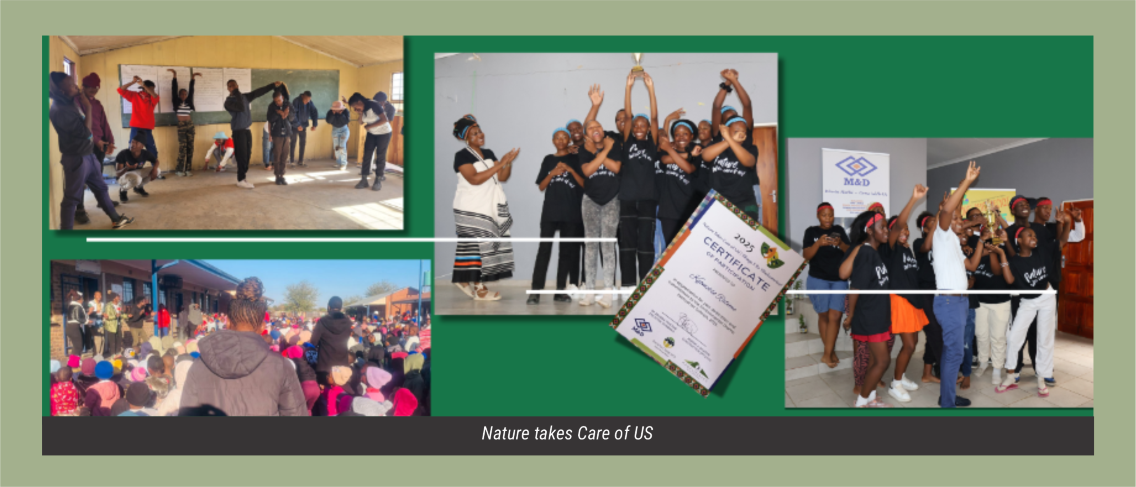
Making sense of the Magaliesberg Protected Environment, its
Management and Regulation.
The Magaliesberg Protected Environment (MPE) is one of the region's most significant conservation tools, defining how land use, biodiversity protection, and development are balanced across this unique landscape. Landowners, communities, and interested stakeholders should understand what management of the MPE means in practice, and how their ongoing engagement and participation are important for shaping the future of the MPE as we embark on changes to its regulatory framework.
This article will focus on the MPE and its management, since the North West Department of Economic Development, Environment, Conservation and Tourism (DEDECT) is currently developing regulations for it. This process represents an important step in strengthening the regulatory framework for the MPE and is likely to have practical implications for land use and management across the area.

Protected Areas in South Africa
Our National Environmental Management Protected Areas Act, (Act No. 57 of 2003) (friendly term being the NEMPAA) provides for the protection and conservation of ecologically viable areas representative of South Africa’s biological diversity and its natural landscapes and seascapes in a system of Protected Areas. Four Protected Area types are declared under the Act. They are National Parks, Nature Reserves, Special Nature Reserves and Protected Environments. Protected Areas also include World Heritage Sites, Marine Protected Areas, Forest Protected Areas and Mountain Catchment Areas that are declared in terms of other Acts.
The Magaliesberg Biosphere contains several protected areas within its boundary - a few private and state-owned Nature Reserves, the Cradle of Humankind World Heritage Site and the Magaliesberg Protected Environment. Most of these form part of the Biosphere’s Core Zone because they are formally protected areas, under the NEMPAA.
Background to the MPE
Many years of effort to protect a section of the Magaliesberg mountains, a unique range of great geological, ecological and cultural importance and value, culminated in the proclamation of the Magaliesberg Protected Natural Environment in the Administrator’s Notice 126 of 4 May 1994 in accordance with Section 16 of the Environment Conservation Act (Act No. 73 of 1989).
Across two Provinces, about 950 properties, along the Magaliesberg Range between the Kgaswane Nature Reserve in Rustenburg and the N1 in Pretoria, make up the Magaliesberg Protected Natural Environment (now referred to as the Magaliesberg Protected Environment MPE).
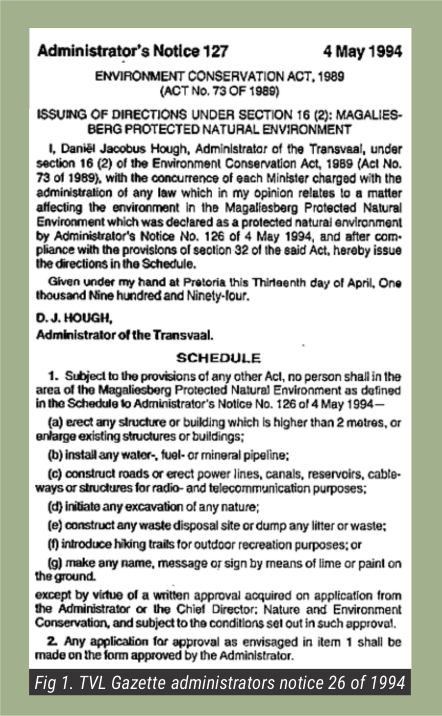
The Administrator’s Notice 126 of 4 May 1994
The notice is used as a control measure. It does not cover all activities that happen in the MPE, but it offers directions in prohibiting certain activities subject to approval by the Administrator or Chief Director: Nature and Environment Conservation (see info box, FIG 1)
The transitional arrangements from the Environmental Conservation Act of 1989 to the NEMPAA (2003) are designed to ensure continuity, meaning that existing provisions remain valid until they are formally replaced, and that past actions, decisions, permits, or approvals remain recognised under the current legal framework.
In our case, this means the restrictions listed under the Administrator's notice are still valid until they are replaced with new Regulations made by the MEC in accordance with section 51 and 87 of the NEMPAA. As of 31 March 2026, the new regulations for the MPE are in draft but have not yet been published in the Gazette for public comment. Once published, this will provide an important opportunity for public review and input.
Management of Protected Environments
Of the four NEMPAA Protected Area categories, Protected Environments are the most flexible in their protection: while their purpose is biocultural conservation, certain areas within them maybe suitable for sustainable land-use, for example, certain types of farming or eco-tourism. Importantly, too, land uses that existed before the declaration as a Protected Environment (i.e.before 1994) may continue (provided their continuance does not jeopardise the purpose of the Protected Area). However, any new activity or development after declaration would be subject to the provisions of the NEMPAA and the land-management tools associated with it.
Besides the NEMPAA, there are published Norms and Standards for the Management of Protected Areas in South Africa (31 March 2016). Together, this legislation establishes the mechanism for the management and regulation of a protected area. The management and regulation of a Protected Environment have three components.
The minister or MEC of the province (in our case, DEDECT MEC):
• may appoint a management authority for the Protected Environment,
• may adopt a management plan for the Protected Environment and
• may make regulations for a Protected Environment.
Although the MEC has discretion in relation to these actions, the effectiveness of a Protected Environment in practice is closely linked to the extent to which these management tools are implemented and aligned to optimally manage the area for the purpose for which it was declared.
-1.png "Protected Areas Register - MPE map (1)-1")
Management Authorities for Protected Environments
In terms of section 92(2) of the NEMPAA, if an organ of state was already managing a protected area before it came into effect, that body must keep managing that area until the area is assigned to it, or to another management authority in line with Chapter 4 of NEMPAA. In the case of the MPE, no management authority has been assigned to it in terms of NEMPAA .However, DEDECT is currently the Management Authority, in terms of section 92(2), although the interprovincial arrangements underpinning this role may benefit from further clarification as the process evolves.
Chapter 4 section 38 (2)b of NEMPAA, which deals with Management Authorities, provides that the MEC “may assign the management of a protected environment to a suitable person, organisation or organ of state, provided that the owner and lawful occupier have requested or consented to such assignment, and the MEC has given the owner and lawful occupier notice in writing in terms of section 33”.
It also provides for the co-management of a protected area, where a Management Authority may enter into a co-management agreement with another organ of state, local community, individual or another party to jointly undertake all the duties and functions assigned to Management Authorities.
Management Authorities have the statutory responsibility to comply with NEMPAA requirements and to enforce compliance with Management Plans and Regulations for the Protected Environment. It is the Management Authority that would normally take the initiative on any expansion plans for the Protected Environment and foster cooperation with properties along its boundary and buffer zone in the interests of supporting protected area objectives.
Management Plans for Protected Environments
One of the first assignments for a Management Authority is to draft and submit a Management.Plan for the Protected Environment to the MEC for approval, within 12 months of being assigned. The management plan must be developed through consultation with all relevant organs of state and interested and affected parties. It aims to ensure protection, conservation, and proper management in alignment with the objectives and purpose of the Act. It must include essential elements such as biodiversity management protocols, an aligned policy framework, implementation of conservation and education activities, community-based management and sustainable use of resources, governance aspects and zoning of the area that indicates appropriate activities for each zone, and a buffer zone of influence. Additionally, it will inform and guide the Management Authority in regulating the Protected Environment. In 2009, an MPE Environmental Management Framework and Plan was gazetted, but to date, a NEMPAA-prescribed Management Plan for the MPE has not yet been drafted.
Regulations for Protected Environments.
The administration of the Act (sections 51, 86–88) empowers the MEC to make regulations that support the effective management and conservation of a Protected Environment through its Management Authority. It is worth noting that requirements for licences/ authorisations/approvals or permits under any other law and any other competent authority's jurisdiction still apply.
Rather than itemising specific restricted activities (as per the 1994 notice), the new draft regulations introduce a spatial zoning plan that applies across the MPE and a 5km buffer area,enabling different levels of control depending on the ecological sensitivity of each zone. While this approach provides a clear spatial reference for decision-making, it must be guided by how zoning is interpreted and applied in practice through its Management Plan, given the broad range of activities that are restricted and subject to Management Authority approval.
What comes next?
In a nutshell, under the NEMPAA and Norms and Standards for Protected Areas, a single suitable Management Authority for the MPE may be assigned by the MEC. In the case of private land, the owner/lawful occupier must consent to the assignment. The Management Authority is then required to develop a Management Plan for the MPE, for submission and adoption by the MEC. The Management Authority then manages the MPE in accordance with its Management Plan and its regulations that guide all activities in line with the Act.
As these processes unfold, there will be opportunities for stakeholders to engage—both through formal public participation processes and through longer-term collaborative structures. Active participation by landowners, occupiers, representative organisations, Traditional Authorities and other stakeholders will be important in shaping a practical and effective management approach for the MPE. Over the long term, this could be a co-management structure with DEDECT, as provided for in section 42 of NEMPAA. The Magaliesberg Biosphere will explore optionson how such a co-management structure can be realised. Further information on opportunities for engagement will be shared as processes progress.
Contact hello@magaliesbergbiosphere.org.za with any queries.